Over-Water Flying (AFW Jan-Mar 2026)
This article was published in the January – March 2026 issue of Aviation for Women Magazine.
by Liz Booker
Wait for violent motion to stop. Reference point—locate and hold. Door jettison handle—release. ICS cord—disconnect. Seatbelt/Harness—release. Egress—maintain reference points and exit at right angles. Life vest—inflate when clear of aircraft.
I visualized these procedures every time I strapped in for an over-water night flight, moving my hands in sequence, tapping the blunt-tipped knife clipped to my right boot, and locating the flap on my survival vest that housed my HEEDS oxygen bottle. As a Coast Guard H-65 Dolphin helicopter pilot, I wasn’t limited to visualization. We trained in the dunker every six years, and in a local pool once a year, wearing blacked-out goggles and flipped upside-down in the water. We did annual survival training and practiced climbing into the life rafts we carried in the aircraft, inventoried our survival equipment, and shot off flares.
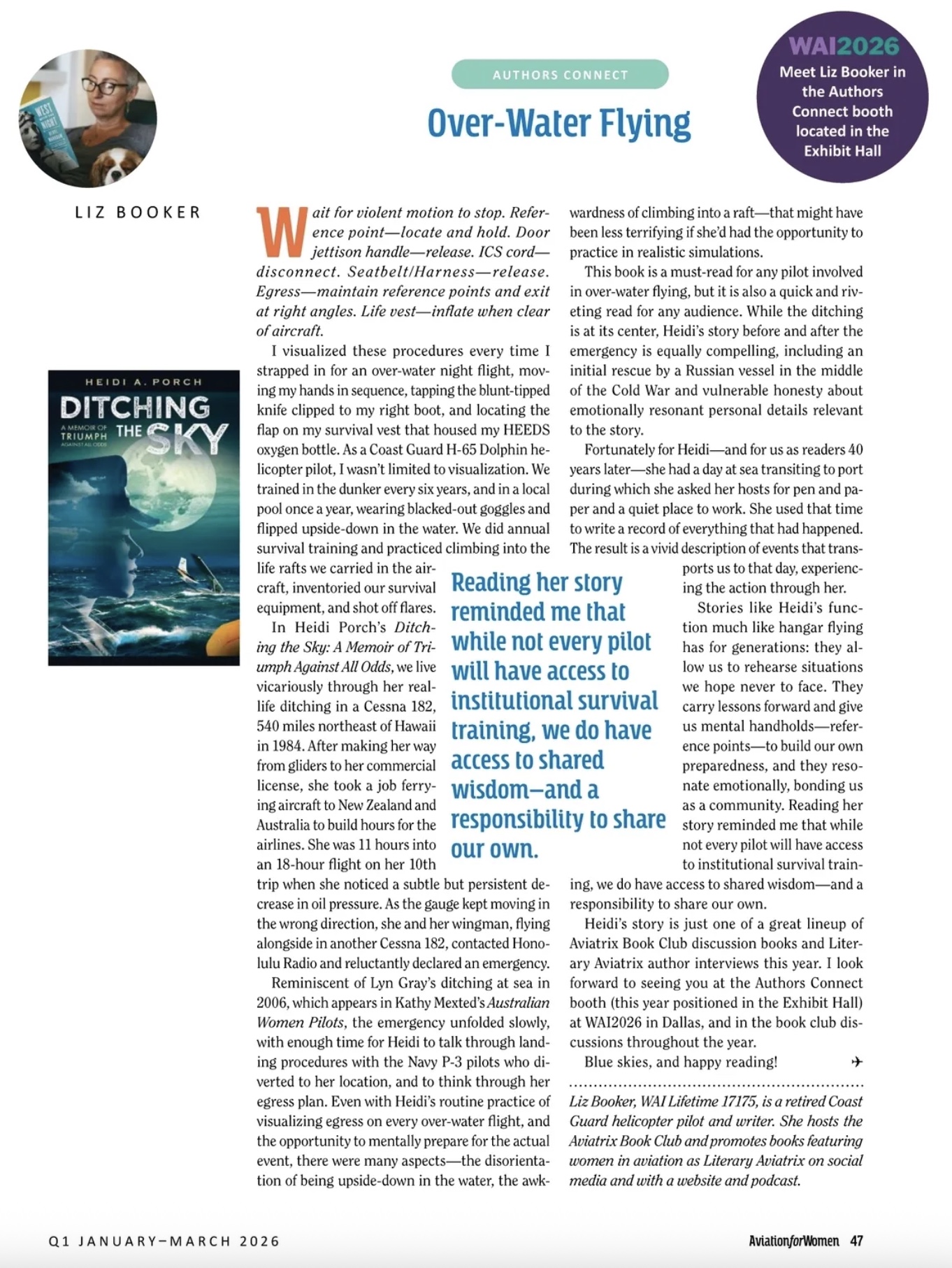
In Heidi Porch’s Ditching the Sky: A Memoir of Triumph Against All Odds, we live vicariously through her real-life ditching in a Cessna 182, 540 miles northeast of Hawaii in 1984. After making her way from gliders to her commercial license, she took a job ferrying aircraft to New Zealand and Australia to build hours for the airlines. She was eleven hours into an eighteen-hour flight on her tenth trip when she noticed a subtle but persistent decrease in oil pressure. As the gauge kept moving in the wrong direction, she and her wingman, flying alongside in a Cessna 172, contacted Honolulu Radio and reluctantly declared an emergency.
Reminiscent of Lyn Gray’s ditching at sea in 2006 which appears in Kathy Mexted’s Australian Women Pilots, the emergency unfolded slowly, with enough time for Heidi to talk through landing procedures with the Navy P-3 pilots who diverted to her location, and to think through her egress plan. Even with Heidi’s routine practice of visualizing egress on every over-water flight, and the opportunity to mentally prepare for the actual event, there were many aspects—the disorientation of being upside-down in the water, the awkwardness of climbing into a raft—that might have been less terrifying if she’d had the opportunity to practice in realistic simulations.
This book is a must-read for any pilot involved in over-water flying, but it is also a quick and riveting read for any audience. While the ditching is at its center, Heidi’s story before and after the emergency is equally compelling, including an initial rescue by a Russian vessel in the middle of the Cold War and vulnerable honesty about emotionally resonant personal details relevant to the story.
Fortunately for Heidi—and for us as readers forty years later—she had a day at sea transiting to port during which she asked her hosts for pen and paper and a quiet place to work. She used that time to write a record of everything that had happened. The result is a vivid description of events that transports us to that day, experiencing the action through her.
Stories like Heidi’s function much like hangar flying has for generations: they allow us to rehearse situations we hope never to face. They carry lessons forward and give us mental handholds—reference points—to build our own preparedness, and they resonate emotionally, bonding us as a community. Reading her story reminded me that while not every pilot will have access to institutional survival training, we do have access to shared wisdom—and a responsibility to share our own.
Heidi’s story is just one of a great lineup of Aviatrix Book Club discussion books and Literary Aviatrix author interviews this year. I look forward to seeing you at the Authors Connect booth at WAI 2026, and in the book club discussions throughout the year.
Blue skies, and happy reading!